Quentin Botha, Christoph Siebenbrunner, and I have two papers at BCCA 2026 (8th International Conference on Blockchain Computing and Applications), taking place November 16-20 in Barcelona, Spain.
The two papers ask one question from two ends: when an autonomous agent breaks something on infrastructure it does not own, who is accountable? Agents already update databases, push to repositories, call cloud APIs, and delegate to other agents, and those actions routinely cross organizational boundaries. At that boundary, two things get hard. Proving what actually happened, on records nobody can quietly rewrite after the fact. And compensating whoever was harmed, without depending on the goodwill of whoever operated the agent. The first paper is about evidence. The second is about settlement.
Agent Flight Recorder
Long-horizon agents execute thousands of actions, so the failures that matter are wrong sequences rather than isolated errors. By the time anyone investigates, the trail is the evidence. Observability stacks produce such trails, but the trails live in mutable logs that the operator both produces and consumes. For debugging, that works. For a dispute, it does not. This is the operator grading its own homework.
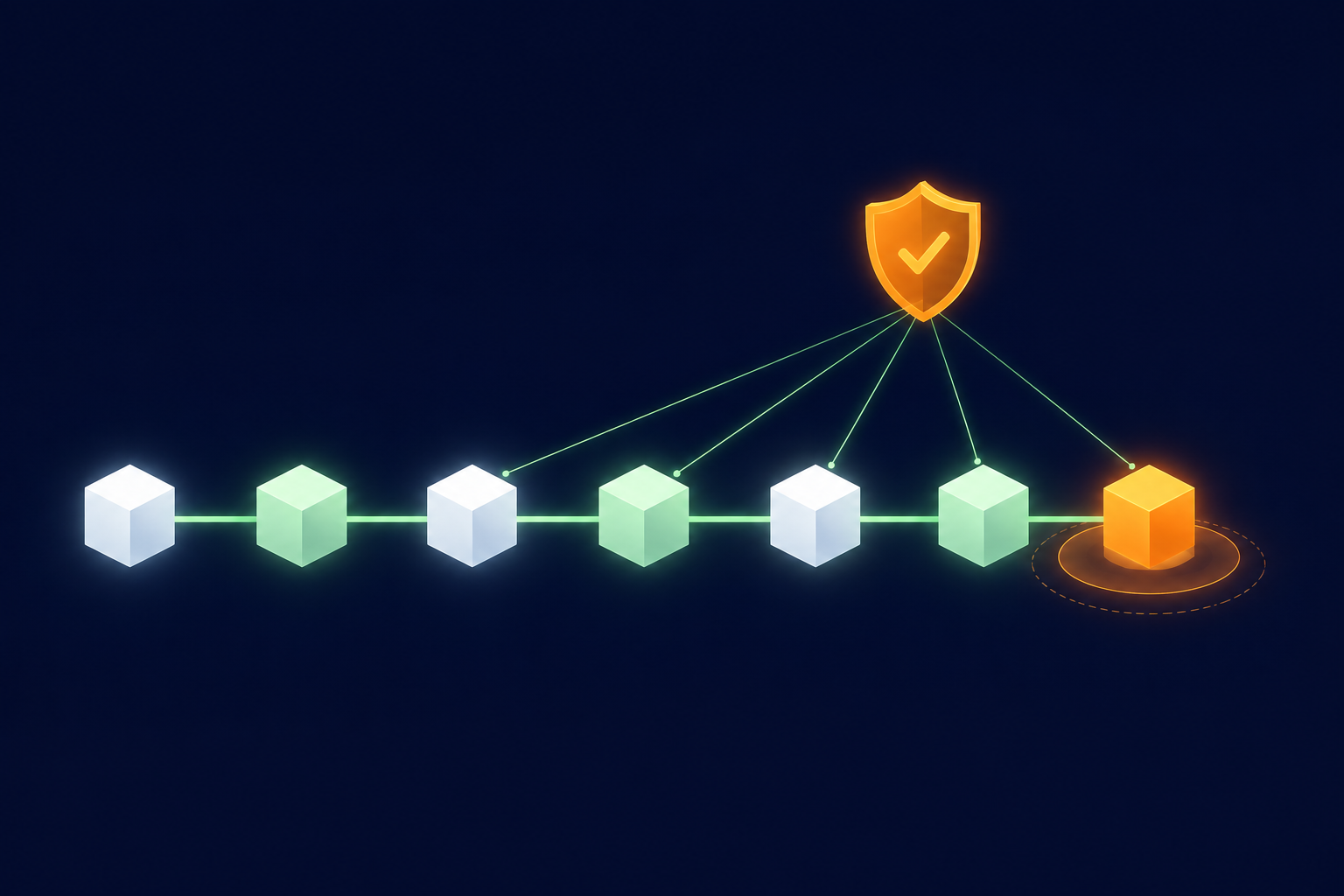
The Flight Recorder turns the trail into evidence. Every agent action becomes a structured, tamper-evident event, hash-chained to the one before it. When a dispute crosses organizations, there is no infrastructure both parties already trust, so the system periodically anchors the record on-chain, allowing a verifier holding the disclosed payload to check it independently, without pre-agreeing on a trusted intermediary. No event content ever touches the chain, making the overhead small enough to leave on in production.
Bonded Recourse
Bonded Recourse for Smart-Contract Settlement of Compensable Agent Side Effects
Authorization decides which actions an agent may run. Local compensation covers failures that can be rolled back inside the runtime. Neither settles the harm that remains after a permitted action fails: the deleted database is restored from the snapshot, the outage still cost real money, and somebody is holding the bill.
Recourse settles that bill. Before an action runs, it is bound to a scope, a recovery path, and collateral. When it fails anyway, typed receipts decide the payout through smart contracts: objective claims settle automatically under an optimistic challenge window, and subjective ones go to arbitration. We implemented and deployed the full contract suite on Base Sepolia, and against baseline systems that only authorize or roll back, the bond cut uncompensated harm roughly in half. This is what the chain is for: custody nobody controls, a challenge procedure nobody can skip, and history nobody can rewrite.
Both papers came out of a collaboration with the Research Institute for Cryptoeconomics at WU Vienna, and they would not exist without Quentin and Christoph. Congratulations and thank you to both. We will present the papers at the conference in Barcelona in November.